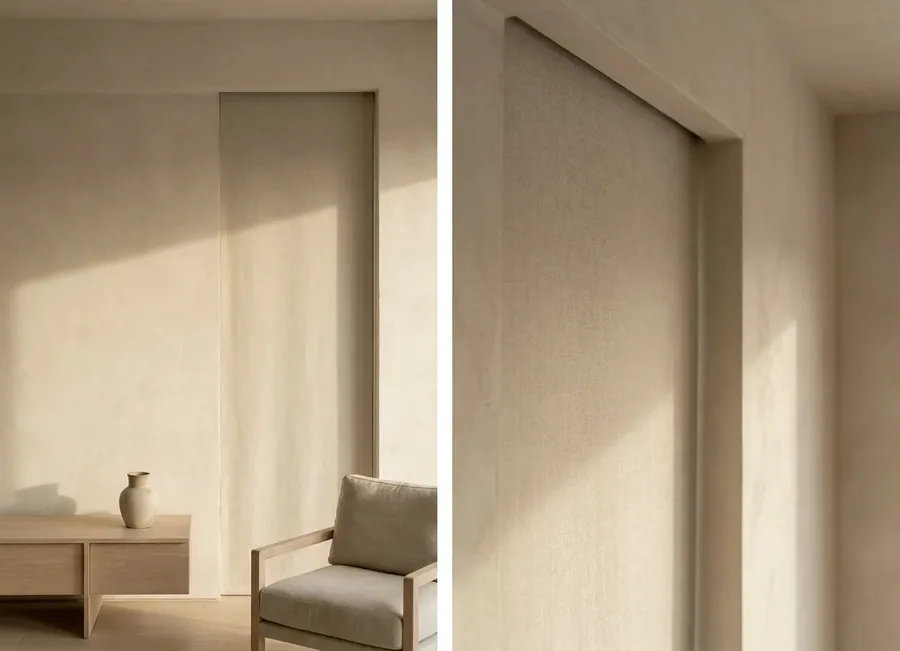
This is the product that rewards timing more than any other on our range. Get it into the drawings — or at least into a conversation with your builder — while the ceiling bulkhead is still stud and board, and the result is a blind that appears to have been designed into the house from day one. Retrofit it after handover and you're looking at a surface-mounted cassette instead, which still works but never disappears quite the same way.
Who this is genuinely for
- New-build homes across Boardwalk Meander and the surrounding Pretoria East estates, where the recess can still be planned into the ceiling drawings — the earlier we're involved, the cleaner the result.
- Open-plan living rooms with frameless glass or double-volume stacking doors, where a bulky surface cassette would compete with the architecture rather than disappear into it.
- Homeowners further along in the build who've missed the ceiling stage — retrofit is still possible with a surface bulkhead or a slim cassette pelmet colour-matched to the ceiling, just with a slightly different finished look.
What matters technically
- Recess depth varies by blind type — a roller needs roughly 110–150mm depending on tube and fabric drop. We'll confirm exact specs for your system at the measure rather than have your builder guess on site.
- Almost always motorised — reaching a hand into a ceiling slot rather defeats the point, and the wiring is far easier to run before the bulkhead closes.
- Needs coordinating with downlights, aircon diffusers and curtain pelmets at design stage, which is exactly why this conversation belongs with your builder or architect, not after the ceiling boards go up.
The best time to plan the blinds is while the electrician is still on site.
What it costs, honestly
Premium, and worth putting numbers to. Per square metre installed, a hand-operated concealed or recessed system runs R1,600 to R3,000, and a motorised one R3,200 to R5,000. A ceiling void already framed with a pocket sits low in those bands; a bulkhead formed or cut back afterwards sits high in them, which is the whole argument for talking to us before the ceiling closes.
What those figures do not carry is the building work that creates the recess, or the electrical point a wired motor needs at the head of the opening — both belong to the trades doing them. Small openings attract a minimum. We will price it properly, in writing, once we have seen your drawings or your actual ceiling.
Asked at almost every measure
How early do you need to be involved?+
Ideally while the bulkhead is still stud and board — that is when the recess, the power point and the downlight positions can all still move. A conversation at plan stage is better still, and it costs nothing.
Who builds the recess, you or our builder?+
Your builder or ceiling contractor builds it. We hand over the exact dimensions, the power position and the clearances in writing, then come back and install once the ceiling is closed and painted.
What if the recess ends up slightly wrong?+
It is usually recoverable, often with a packer or a slimmer tube — but it costs time on site. That is exactly why we would rather give your builder a spec sheet up front than be called out to solve it afterwards.
We build concealed boxes into new ceilings across the wider new-build corridor too, wherever the bulkhead is still open: