Where the sun lives all winter: high enough in December that a decent eave does much of the work, then low at 40° and pouring straight in by June.[4] On a cold Highveld morning that winter sun is worth money, so a plain blockout roller down all day costs you the warmth you were entitled to.
01 — The starting point
Why a Boardwalk Meander home gets its own shading brief
Boardwalk Meander is a roughly twenty-hectare lifestyle estate tucked into Faerie Glen, Pretoria East — houses, townhouses and apartments laid out around landscaped grounds "designed around nature," with wooden and paved walkways along the banks of four lakes, a clubhouse, tennis and squash courts and a swimming pool.[1][2] It reads as a garden suburb with a wall around it, and that character shapes everything about the glass.
These are patio homes. The estate's signature isn't a golf frontage — it's the family entertainment area: a covered braai patio, sliding doors that fold the living room open onto a small private garden, and the open-plan volume behind them. That is a beautiful way to live and a great deal of unmanaged glass, and on a hot Pretoria East afternoon an open room with no shading plan heats up fast and stays that way.
The gardens are grown, but they don't shade the window that matters. Established in the early 2000s, Boardwalk Meander has had two decades for its planting to fill in, so there's more canopy here than in the newest Pretoria East estates.[1] But mature trees soften a street; they rarely stand exactly between the low western sun and a living-room slider. West-facing patios and lounges still take the afternoon full on.
And the layout hides which way you face. The internal roads curve through the grounds rather than following a tidy grid, so two neighbours can face completely different directions — which is exactly why a guide can tell you what the sun does over the estate, but only a compass on your own wall tells you what it does to your lounge. We come back to that at the end.
02 — The light here
What the Highveld sun actually does over this estate
Faerie Glen sits at about 25.78° south, on the southern slopes of the Bronberg ridge.[3] The most-cited South African study of sun, shade and daylight in town planning is calculated for Pretoria at 25.733°[4] — a few hundredths of a degree away, so its numbers are effectively the estate's own.
At solar noon on 21 December the sun reaches 87.7°: near enough straight overhead. On 20 June it reaches only 40.84°.[4] That 47-degree swing is why one blind rarely answers a whole room across the year.
The sunset bearings matter even more on a patio. On 21 December the sun sets at an azimuth of 243.35° — twenty-seven degrees south of due west; on 20 June at 295.76°, twenty-six degrees north of it.[4] The setting sun sweeps a fifty-two-degree arc along your western horizon through the year, so a fixed eave built for one of those positions is wrong for the other.
In the study's own terms: western afternoons run significantly hotter than mornings, horizontal overhangs suit the high, altitude-dominated sun on northern facades, and low, azimuth-dominated sun east and west wants vertical control instead.[4] Plainly — an eave earns its keep on north glass and does almost nothing against four o'clock on the west.
Sun altitudes and sunset bearings from the published Pretoria figures at 25.733° S[4] — Faerie Glen is a few hundredths of a degree away.
Three more facts that change what we'd specify
- High ground, harder UV. Pretoria sits at roughly 1,330–1,340 m above sea level, and Faerie Glen, on the Bronberg slopes, is a touch higher again.[5] UV rises about 12% per 1,000 m because thinner air filters less of it,[6] so west-facing fabric ages faster here than at the coast: on the sun side, choose fabric on performance first and colour second.
- Storms come in the afternoon, and this is the hail belt. Almost all of Pretoria's ~700–800 mm of rain falls in summer, in fast electrical storms that build over the Highveld from about 3pm and clear by sunset.[5] The Highveld's hail season peaks in the first half of November over Gauteng, with the peak hour between 16:00 and 17:00.[7] That is exactly the hour an awning is out.
- Winter nights are cold and clear. Highveld winters are dry with virtually no rain and frosty nights,[8] so on a north or south elevation the question quietly flips from keeping heat out to keeping it in — a blind's insulating value matters as much as its shading value.
03 — Room by room
Elevation by elevation, and which rooms suffer
One house, four different problems. Before fabric, before motors, work out which wall the room sits on — it decides more than anything else here.
Low, almost horizontal sun from three o'clock, landing anywhere across a 52-degree spread depending on the month[4] — and on most Boardwalk homes it's also the elevation the patio and the garden view face. If the lounge is unbearable at four, the glass itself is heating and radiating inward: an interior blind fixes the glare at once and the heat only partly.
The same geometry mirrored, into a house that has cooled all night. In December the sun clears a low horizon early, and in a townhouse cluster it often clears a neighbour's roof straight onto the bedroom window — and two rooms on one wall frequently want opposite things: properly dark where you sleep, still see-through where you take your coffee.
Almost no direct sun for most of the year, so south rooms hold the steadiest light in the house — and are first to feel a cold, clear Highveld winter night.[8] Shading is rarely the issue here; heat loss through a big pane usually is.
Optional
Want this Playbook marked up for your own house?
Tell us which rooms are giving trouble and we'll email you this same Playbook with your elevations noted against it — which windows we'd treat first, and what we'd be weighing up on each.
It's an email, not a visit. Nobody phones you about it.
04 — The specification
What we'd fit in Boardwalk Meander, and the catch with each
Each of these is right somewhere in an estate home and wrong somewhere else. The trade-off box is the part a brochure leaves out. Tap "Add to my list" and it carries into the window list and the measure form below — no retyping.
Sunscreen roller blinds
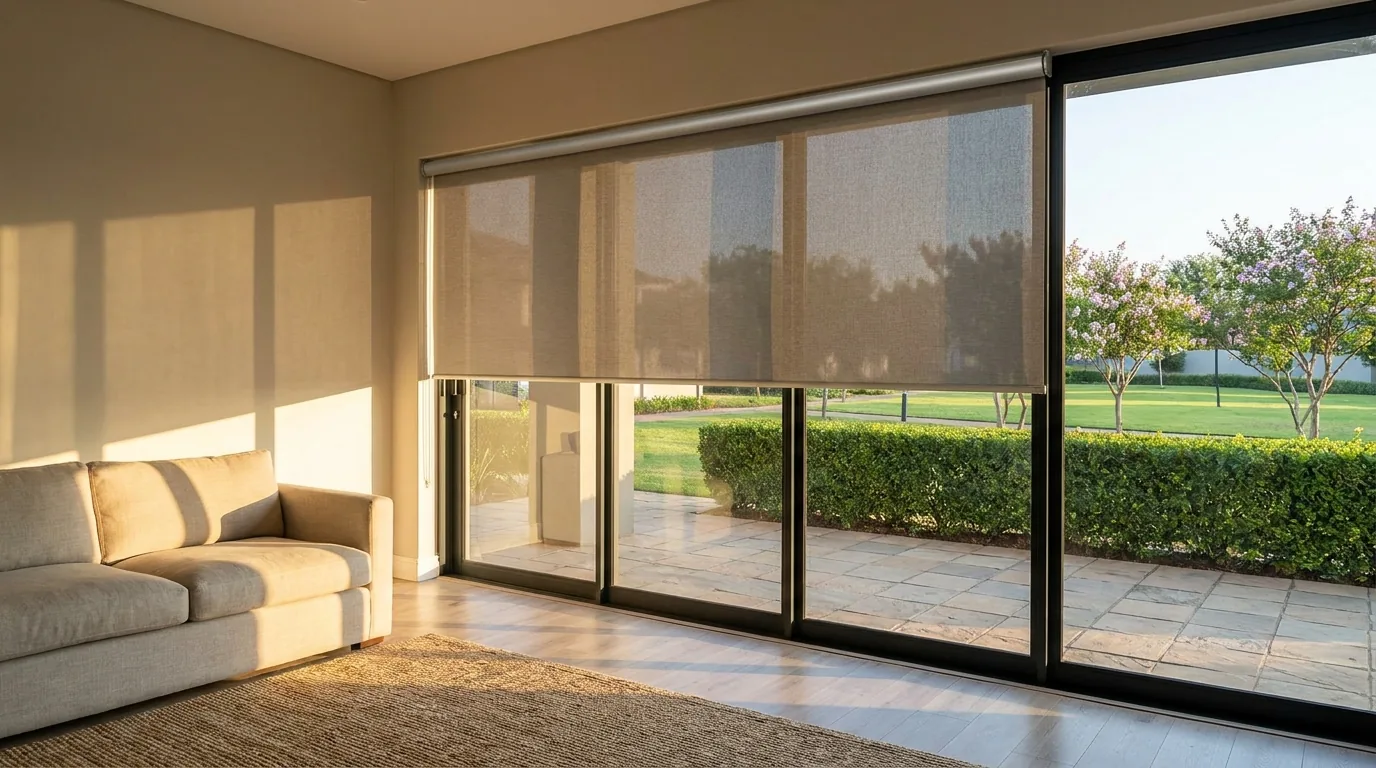
Patio- & garden-facing living glassOne flat sheet of open-weave fabric on a slim tube — no folds, no gathers. It cuts glare and a useful share of the solar gain while leaving the garden and patio visible, which here is the point of the window. Better than a lined curtain, which solves four o'clock by deleting the view you bought the house for.
It reverses after dark: lights on inside, and you become the visible one. On a townhouse where a neighbour's window is close, pair it with a blockout on the same bracket.
Blockout roller blinds
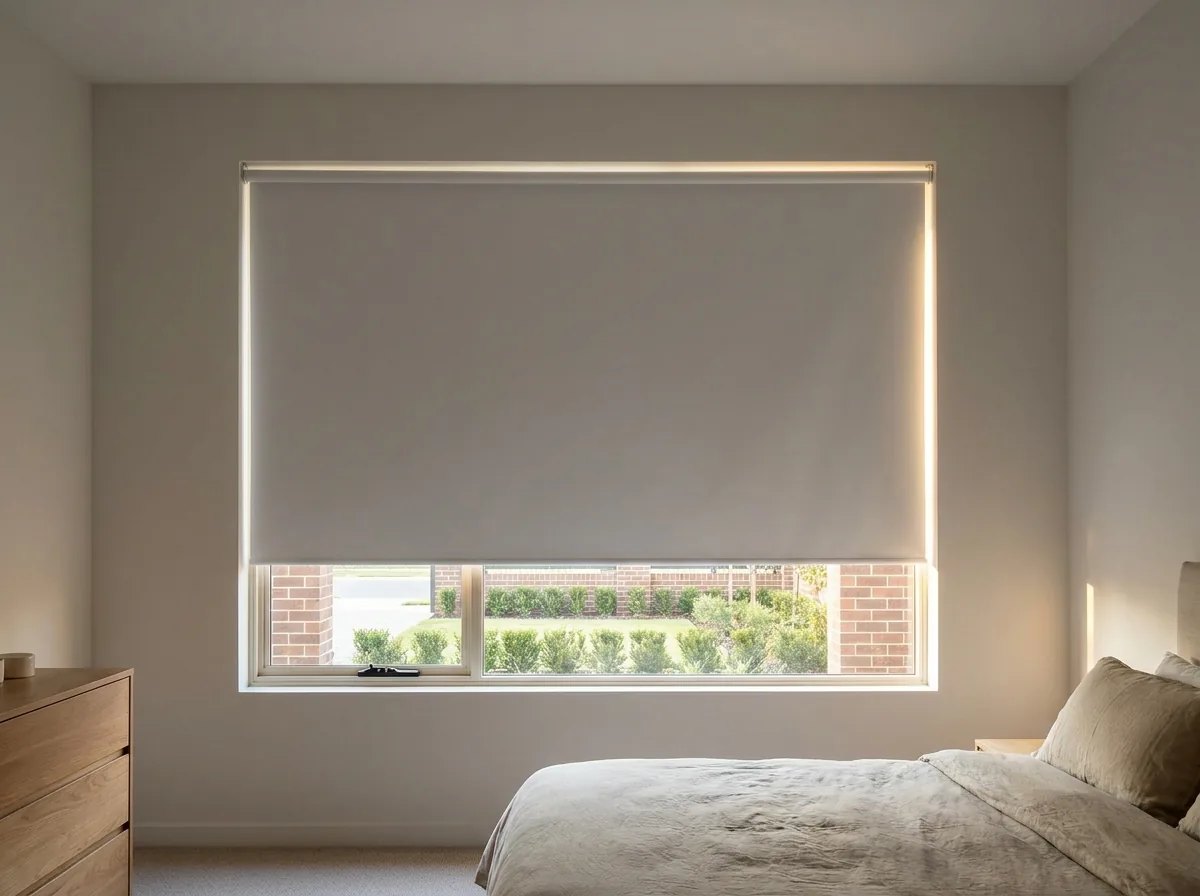
Bedrooms · east elevationsA single smooth sheet, no folds for Highveld dust to settle into, and a real thermal layer on a cold night. Against a low December sunrise over an east-facing garden, nothing else comes as close to genuine darkness.
Binary — down is dark, up is everything — so it's the wrong tool on a north living room where you actually want the June sun. Without side channels, light finds the edge of the reveal.
Day-night blinds
Open-plan living areasAlternating sheer and solid bands slide past each other, so one blind runs from full garden view to privacy-and-dark like a dimmer — the natural pick for a Boardwalk open-plan living space where the light changes through the day.
The sheer bands still reverse for privacy after dark, and it's a lighter-duty answer than exterior shading on a genuinely hot west wall — a light-control tool first, a heat tool second.
Timber & aluminium venetian blinds
North rooms · sculleries · bathroomsOn a north elevation the useful control is angle, not coverage: a venetian throws high December sun up onto the ceiling and opens flat in June, so one product handles both ends of that 47-degree swing a roller can't.[4] Warm timber suits a living room; crisp aluminium shrugs off steam in the scullery, guest bathroom and laundry.
Slats collect dust and take longer to clean than a flat roller — aluminium wipes down far more easily than timber, worth remembering on a big north wall. Timber doesn't belong in a steamy room.
Cellular / honeycomb blinds
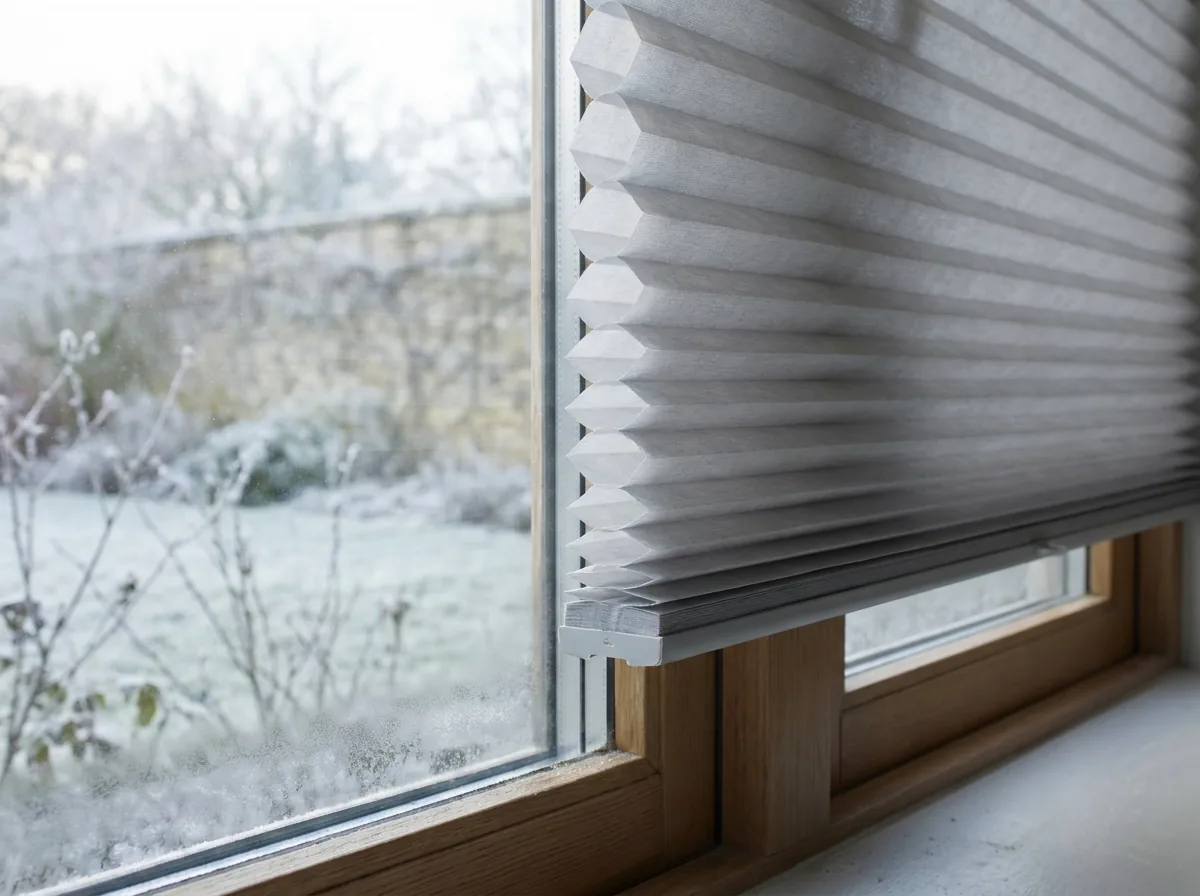
Nurseries · south rooms · studiesThe fabric cells hold still air against the glass — the best-insulating, quietest fabric blind we fit. In a nursery, a study, or a south room that feels the cold on a clear winter night,[8] it's the cheapest thermal improvement short of replacing the window, and cordless as standard.
The gain sits on the winter side of the ledger — it's not a heat-rejection answer for a hot west wall, and as a soft pleated product it's the wrong choice in a dusty scullery.
External venetian blinds
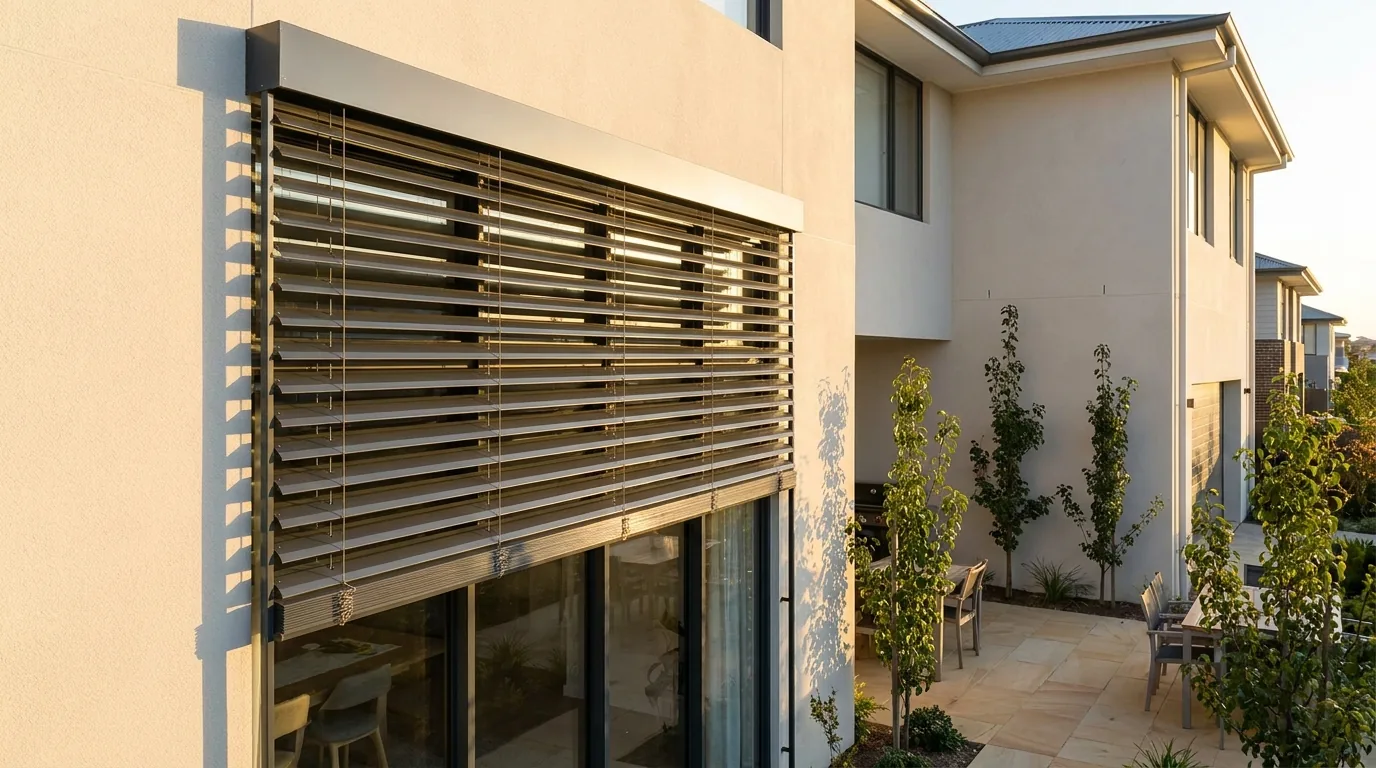
Hard west & north-west glazingAluminium slats in side guides, mounted outside the glass. We'd specify these over an interior blockout roller on a hard west wall for a physical reason: turning the heat away outside the pane keeps a room cooler than absorbing it inside, where the glass warms and radiates at you all evening. Tilted, they still keep the view.
The premium option, visible on the facade, and living outdoors in a hail belt that peaks in the late afternoon.[7] We'd motorise it with a wind sensor — and it's an item the estate will want to sign off, so plan the colour early.
Roller shutters (shading)
West walls · exposed elevationsRigid aluminium slats rolling down from a headbox outside the building, covering the whole opening — heat and glare stopped before the glass, with real insulation when fully closed. Shading, not security: these are shading roller shutters, not security-rated shutters, which are a different product, built and certified differently, and quoted on request.
The most visible exterior change on this list, and the headbox has to live somewhere — a design decision, not just a measurement. Closed is closed: full coverage, not adjustable light.
Folding-arm awnings
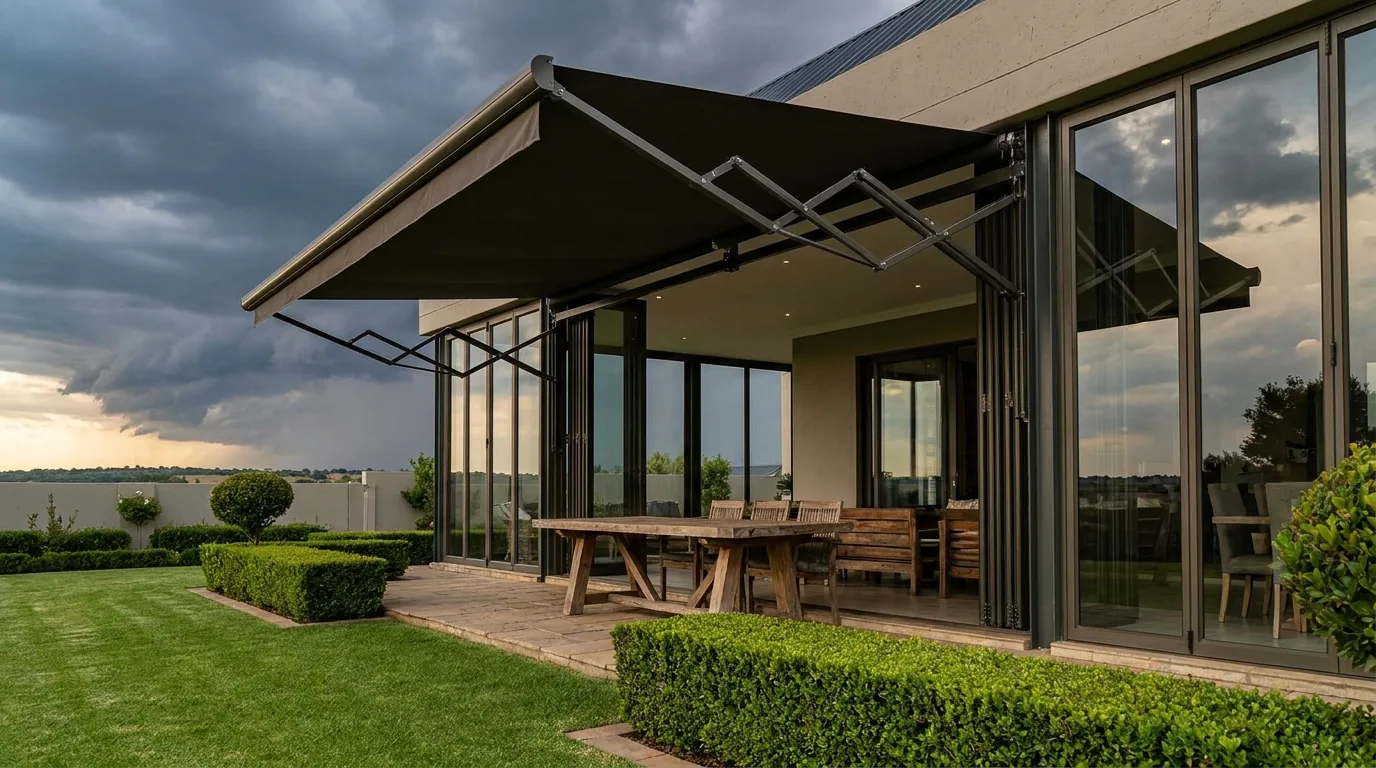
The entertainment patioWhere the outdoors is the extra room — and in Boardwalk Meander the patio always is — an awning buys more usable house than anything you could do to a window, then folds away and gives back the low winter sun on the paving.
It lives out in the weather, and Highveld hail peaks between four and five in the afternoon.[7] We'd specify a full cassette and a wind sensor that retracts it whether or not you're home — the responsible spec, not an optional extra.
Concealed & recessed blind boxes
New builds · double-volume windowsThe fabric drops from a slim slot in the ceiling or bulkhead with every bracket hidden — when the blind is up, the window is just glass and frame. It's the product that rewards timing most: get it into the drawings while the bulkhead is still stud and board and it looks designed in.
Retrofitting into a finished ceiling is possible but rarely invisible, which is why we like to be in early. In an existing room a colour-matched cassette pelmet gets most of the way there.
Motorised blinds & automation
Wide stacking doors · anything exteriorOn Boardwalk's four- and five-metre stacking doors this is less about luxury than reach: a blind that wide is heavy by hand and gets used exactly never if you need a pole, and any exterior product wants a wind sensor to save itself in a November storm.[7] One app can run a whole ground floor at once.
It needs power at the head of the opening — battery, wired or solar. On a new build the cable goes in before the walls close; in a finished home a rechargeable battery motor avoids the chasing but needs charging a few times a year.
Also on the window list below, for the openings this estate is full of: vertical & panel blinds for wide stacking doors onto the garden, skylight & shaped blinds for gable glass and stair-void windows, motorised curtain tracks for heavy lined curtains, zip screens to close the patio against wind, dust and early-evening midges, and blind repairs — re-cording, new chains and tilt mechanisms and motor call-outs, whoever fitted the original blind.
05 — The local constraint
The estate's own rules, and who has to say yes
Like most Pretoria East security estates, Boardwalk Meander draws a clean line through this whole list. Interior blinds inside an existing reveal change nothing you can see from the road or a neighbour's stand, so the question doesn't arise — a roller, a venetian, a cellular blind is your decision alone. Anything that reads on the outside of the house does raise it: awnings, external venetians, roller shutters and zip-screen channels are all visible-from-outside, and estates here generally want them signed off in an approved, neutral palette.
That's a reason to plan those items with the committee in mind, not a reason to avoid them. We spec exterior products in powder-coated finishes across a wide colour range and talk facade-matching through with you before anything is ordered, and we can supply a spec sheet if your HOA wants one on file. We fit blinds and won't speak for your estate — but at the measure we say plainly which options touch the outside, so the right question reaches the right desk before anything is made. (We could not find Boardwalk Meander's specific architectural guidelines published online, so treat this as the general estate norm and check your own HOA pack for the exact rule.)
Building or renovating? Get us in early. A concealed recess has to exist before the ceiling closes, and motor cabling is trivial in an open wall and awkward in a finished one. It's also worth knowing that SANS 10400-XA:2021 raised the fenestration-calculation threshold from 15% to 20% of floor area and no longer draws a distinction between the solar-heat-gain requirements of west-, north- and east-facing glass[9][10] — so ask your architect how your shading is being counted on those big estate windows.
06 — The honest limit of a guide
What we'd still need to check on site
Everything above is what we know about Boardwalk Meander. What no page can know is your house — and five things decide the actual specification, all settled in about an hour with a tape, a compass and a torch.
The true bearing of each wall
On the estate's curved roads "west-ish" isn't good enough when the sunsets are themselves spread across fifty-two degrees.[4] Twenty degrees of wall rotation moves the answer between an interior sunscreen and something outside the glass, so we take a compass reading at every elevation.
Reveal depth, square-ness, and the wall behind it
Depth decides whether a blind can sit inside the opening at all, and how much light creeps round the edge. Openings are rarely perfectly square — and plastered brick, a drywall bulkhead and an aluminium glazing bar are three different fixings.
Wind exposure on the patio
An awning or a zip screen lives or dies on how exposed the patio is once the summer storms build from mid-afternoon.[5] Whether the neighbouring cluster breaks the wind or funnels it is obvious in two minutes on the paving and impossible to judge from a plan.
Where the power is, and how it reaches the opening
For anything motorised the whole constraint is the route from a power point to the head of the window. On a double-volume lounge or a wide stacking door, that walk-around is the difference between a clean install and a compromise.
What's actually outside the glass
How close a neighbour's window, the internal road or a boundary wall sits changes the fabric we'd choose — as does the tree doing half your shading, and whether it will still be in leaf come July.
07 — Two ways forward
Book the free expert measure
A consultant comes out to the home with fabric and slat samples, measures every window properly, and leaves a written quote itemised per window. It costs nothing and commits you to nothing. If you'd rather have a rough number first, the window list sits inside the same form — no obligation either way.
Our consultant does five to six measures a week across Boardwalk Meander and the estates around it, so the diary fills early — worth booking ahead if you need a particular day.
Anything you added to your list while reading is already ticked below.
Neither, for now
Just take the Playbook, marked up
Not ready for a visit or a number? Tell us which rooms are the problem and we'll email you this Playbook with your own elevations noted against it. Nothing is booked and nobody phones.
Working out
Sources
Every geography, climate and regulation claim above traces to one of these. Where we've reasoned from them rather than quoted, we've said so in the text.
- RealNet — Boardwalk Meander area profile: a Faerie Glen, Pretoria East estate of houses, townhouses and apartments (roughly 2–5 bedrooms) with gardens and outdoor entertainment areas, near the Boardwalk Shopping Centre. realnet.co.za — Boardwalk Meander
- Estate Living — Boardwalk Meander Estate: a ~20-hectare estate "designed around nature," with a clubhouse, tennis and squash courts, a swimming pool, a children's play park and walkways along the banks of four lakes. estate-living.co.za — Boardwalk Meander Estate
- Wikipedia — Faerie Glen: a suburb of eastern Pretoria on the southern slopes of the Bronberg ridge, at approximately 25.78° S, 28.31° E. en.wikipedia.org/wiki/Faerie_Glen
- Conradie, D. (2018) "Sun, shade and natural daylight in South African town planning, with emphasis on Pretoria", Town and Regional Planning 73:47–67 — latitude 25.733°, noon solar elevation 87.7° on 21 December and 40.84° on 20 June, sunset azimuths of 243.35° and 295.76°, the finding that western-exposure afternoons run significantly hotter than mornings, and the guidance that horizontal overhangs suit altitude-dominated angles on northern facades while low azimuth-dominated sun wants vertical control. scielo.org.za — S2415-04952018000200005
- Climates to Travel — Pretoria: elevation around 1,340 m on the Highveld, a subtropical highland climate, roughly 700–800 mm of rain falling almost entirely in summer, and fast afternoon thunderstorms that build over the Highveld from mid-afternoon and clear by evening. climatestotravel.com — Pretoria
- Hong Kong Observatory — ultraviolet radiation at high altitude: "For every 1000 m increase in altitude, the UV radiation level will increase about 12%." hko.gov.hk — UV radiation at high altitude
- Punge et al. (2023) "Characteristics of hail hazard in South Africa based on satellite detection of convective storms", Natural Hazards and Earth System Sciences 23:1549–1576 — a convective season peaking in the first half of November over Gauteng, and a peak time of day between 16:00 and 17:00 South African standard time. nhess.copernicus.org/articles/23/1549/2023
- South Africa Gateway — weather and climate: Highveld winters are dry and mild with cold, frosty nights and virtually no rain from around April to September. southafrica-info.com — weather & climate
- Roos Architects — summary of the revised SANS 10400-XA standard (2021 edition): the fenestration threshold rising from 15% to 20% of floor area, and no distinction now drawn between the solar-heat-gain requirements of glazing facing west, north or east. roosarchitects.co.za — revised SANS 10400-XA
- SANS 10400-XA:2021 (Edition 2), The application of the National Building Regulations Part XA: Energy usage in buildings — the current, sole compliance framework for building energy efficiency. uj.ac.za — SANS 10400-XA:2021 (PDF)
Two honest caveats. The solar figures in source 4 are calculated for Pretoria at 25.733° south; Faerie Glen sits a few hundredths of a degree away, so its own angles differ by a fraction — we quote the published numbers rather than invent our own. And the hail, frost and rainfall material is regional Highveld physics, not a Boardwalk Meander measurement: there is no published frost or hail record for this estate specifically, and we could not find the estate's own architectural guidelines online — which is one more reason we look at your particular home in person rather than at a map.
Ready when you are
Now let's look at your actual windows.
One visit, real measurements, a written quote per window — and no obligation to go ahead.