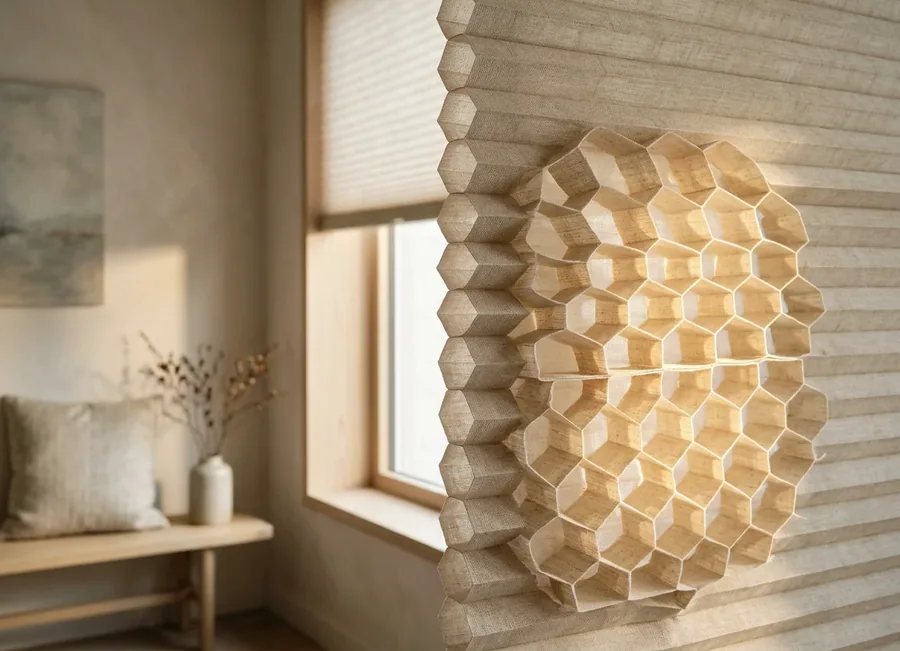
Pleated fabric forms a honeycomb of air cells in profile, and that trapped air is real insulation — a soft thermal buffer sitting right on the glass in both directions. It's the product we reach for whenever a family mentions a room that's always too hot in summer or too cold in winter, which on a new estate is most often the nursery, a north- or west-facing study, or anything above an unheated garage.
The energy pitch, kept honest
Single cells suit mild rooms; double cells do the serious thermal work — cooler in summer, warmer in winter, and quieter too, since the cells absorb sound as well as heat. We'll talk comfort and lower heating and cooling load with you at the measure, but we won't hand you an invented percentage — every home and elevation behaves a little differently.
Options that matter in a family estate
- Light-filtering or blockout cell fabrics — blockout cells give a nursery genuine darkness with the thermal bonus built in.
- Top-down/bottom-up operation: privacy at the bottom, light and sky at the top — ideal for street-facing rooms and homes with close neighbours, which is most of them on a compact new-estate stand.
- Cordless and motorised operation, with the slimmest stack of any blind when raised — nothing dangling in a nursery, nothing bulky at the top of the window.
- Skylight and shaped-window versions are available too — the cell structure holds its shape on an angle.
Blockout cells give a nursery genuine darkness, with a working layer of insulation thrown in.
What it costs, honestly
Mid-to-premium as a category, and here is what that means in rands. Per square metre installed, a hand-operated cellular blind prices at R1,500 to R2,800 — single-cell light-filtering cheapest, double-cell blockout or a top-down/bottom-up head dearest. Motorised, the guide is R3,000 to R4,800.
You are paying for the cell structure, which is the part doing the insulating, so it sits above a flat roller covering the same glass. Openings below roughly a square metre attract a minimum, because the headrail and the labour do not shrink with them. We will still price your exact rooms in writing at the free measure, window by window.
Asked at almost every measure
How much will they actually save us?+
We will not hand you an invented percentage — every elevation and every home behaves differently. What we will say honestly is that a double-cell blind is the best-insulating interior blind made, and the comfort difference in a west-facing room is obvious within a day.
Can we get true blackout in a nursery?+
Yes — blockout cell fabrics give genuine darkness with the thermal benefit built in. Add side channels if you want the last slivers of light around the edges gone as well.
Do they work on a skylight or a shaped window?+
They do. The cell structure holds its shape on an angle better than a flat fabric, which is why cellular is often the pick for roof glass and gable ends.
The same insulating cells go into nurseries and studies across: